31 October 2021

Happy Halloween

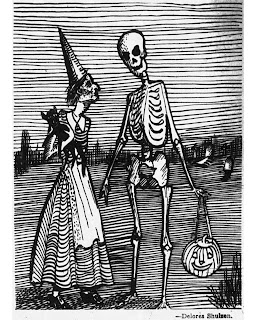
Ruth Delores Shulsen's award-winning Halloween
drawing, from Salt Lake Tribune 1937-10-31

Happy Halloween! This spooky but cute drawing was done by 15-year-old Ruth Delores Shulsen and published on Halloween 1937 by the Salt Lake Tribune (Image 1).

At the time Ruth (Image 2) was a participant of the Tribune-Telegram Youth Activity Club (YAC) which was an organization sponsored by the Salt Lake Tribune in the 1930s. The club offered daily activities for thousands of Utah’s children all taught by knowledgeable adults from the community

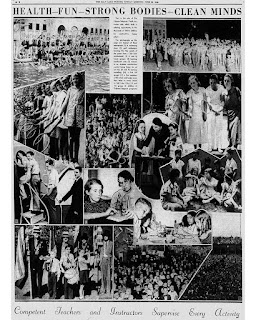
Typical activities of the club included swimming classes, tennis groups, arts and crafts, first aid classes, drum and bugle corps, marching band, movie outings, science and nature classes, woodworking, and a whole lot more. Both boys and girls were encouraged to attend any activity they wished (Image 3).

This drawing won 2nd place in the Youth Activities Halloween drawings contest and Ruth was awarded $2 (~$38 in today’s money). The 1st place drawing was done by Diana McQuarrie and featured a couple in Halloween costumes kissing on the dance floor (personally I like Ruth’s drawing better). Diana was awarded $3 for her drawing.

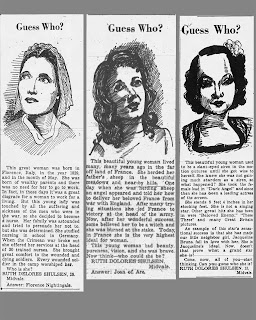
In their Youth Activities Club section of the newspaper, the Salt Lake Tribune also often published Ruth’s drawings of famous women along with a short biography in a section called “Guess Who?” (Image 4).

The Shulsen family lived on a 40-acre farm on the southeast corner of 9000 South and Redwood Road in West Jordan (now occupied by a strip mall, parking lot, and several fast-food restaurants). At the time, West Jordan was very rural and the closest neighbors were a quarter-mile away. Ruth graduated from Jordan High School in 1940 and one year later married the neighbor boy next door, Horace S. Young Jr.

Ruth was knowledgeable about literature and loved to write, draw, and paint with watercolors.

Sources: SL Trib 1937-10-03; SL Trib 1937-10-24; SL Trib 1936-06-28; FamilySearch documents

Ruth Delores Shulsen 17-years-old, from FamilySearch

Youth Activities Club, From Salt Lake Tribune 1936-06-28

Some of Ruth’s “Guess Who?” illustrations,
from SL Trib (L to R) 1938-06-05, 1938-03-06, 1938-01-23

30 October 2021

Deadly Hell’s Hollow


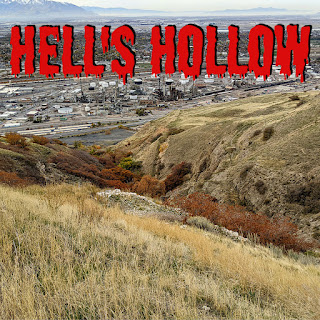
Hell’s Canyon, as viewed from Twickerham Drive SLC.
The history of Hell’s Hollow (now Hell’s Canyon) is full of death. The mouth of Hell’s Hollow is located just above Victory Road at what is now the Staker-Parson’s Quarry and extends northeast toward Ensign Peak.

The first recorded human remains found in Hell’s Hollow was in 1854 and was the body of an unidentified Native American covered with stones. It’s not known what happened with the remains but by April of 1902 they had disappeared when the naked and bound body of Samuel Collins was found.

Samuel Collins was the most sensational death to occur in Hell’s Hollow and captivated the attention of Salt Lakers as the mystery of his murder was unraveled. Collins was murdered on Easter Sunday in 1902 by 14-year-old Clyde Felts. The story of Collin’s death is long and complicated and is retold well by both Ben Williams on his blog of the Utah Stonewall Historical Society Archives and QSaltLake Magazine and by Michael McLane on Mapping Salt Lake City. In the end, Felts confessed to killing Collins at Collin’s request, likely as self-punishment (or even blood atonement) for his pedophilia against Felt and others.

In Jan 1906 another body was found in Hell’s Hollow. Two teenage boys discovered a hand reaching out from the deep snow. Further investigation revealed the dead body of an unidentified man, likely that of a Greek or Austrian. A self-inflicted bullet to the head had killed the man and magpies and coyotes had then preyed upon his body for at least 3 weeks. He was never identified.

In Dec 1911, the skeletal remains of 6 Native Americans were found by workers at the SLC gravel pits (now Staker-Parson’s Quarry). The remains were buried at a depth of 7 feet from the surface, laid in pairs with one facing upward and the other facing downward. When the remains were brought out and were thoroughly aerated, about 1 hour after disinterment, the bones crumbled to powder leaving only a few fragments.

In 1946, 19-year-old Betty Jean Ketter died in Hell’s Hollow of a broken neck due to a fall. She had become ill on the hot August day and was in search of water (heat exhaustion?) and fell from Devil’s Rock.
Murder of Samuel Collins, SL Herald 1902-03-31

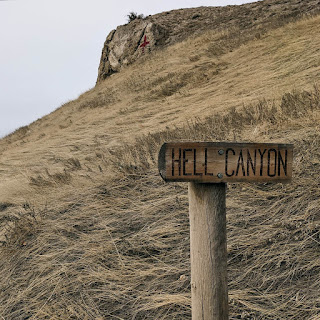
Sign of Hell’s Canyon along the trail

The mouth of Hell’s Canyon, destroyed by the Staker-Parsons Quarry

27 October 2021

Apples and Halloween


Some old magical rituals of Halloween involved apples as part of divination ceremonies, specifically where a girl’s future husband would be foretold.

One practice was for the girl to peel an apple in a single unbroken strip and then drop the peel behind the shoulder. The peel will form a letter that will be an initial of a future husband. Sometimes there are additional steps such as waving the peel three times above the head or saying some specific words while dropping the peel.

Another practice was for a girl to eat an apple in front of a mirror at midnight and then the face of her future husband would make an appearance in the mirror over her shoulder. Sometimes a candle is involved. Sometimes brushing of the hair is required.

Ruth Edna Kelley’s Book of Hallowe’en published in 1919 and now in the public domain (available free on archive.org and Project Gutenberg) states that by 1900 these apple ceremonies were largely considered party games, but these rituals were considered much more serious business in the centuries before.

SLC followed this pattern. During the 1800s, some old-timer Salt Lakers, especially those from Scotland, described these ceremonies in hallowed tones. But by the early 1900s the apple divination rituals were often part of Halloween parties and described in the Society sections of the local SLC newspapers.

Also, in the early 1900s many of these old traditions became immortalized on colorful Halloween postcard greetings (images 1-2). There were even “vinegar” versions of these postcards (image 3) similar to the Vinegar Valentines of the day.

Apples became linked with Halloween through the Roman colonization of the British Isles where the Roman’s autumn apple festival became intertwined with the Celtic Samhain. The tradition then spread to America with the colonization of New England and through the many Mormon immigrants to Utah from the British Isles.


24 October 2021

The Tanned Human Skin at the SLC Police Department

The SLC Police Dept has held onto a strip of tanned human skin for 100 years.

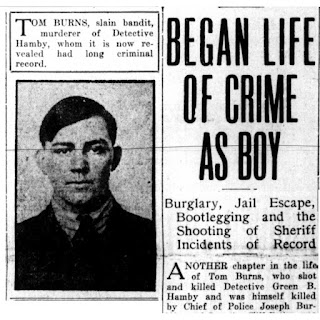
The story begins with a criminal going by the name of Tom “Blackie” Burns. He had several recent aliases including Tom Miller and Tom Gleason but his real name was Joseph C. Alseimer and originally hailed from Madison, Wisconsin where he was well known for his long list of crimes, including a successful jailbreak in 1917.

After his escape from Wisconsin, he came west and went by a variety of his “Tom” aliases throughout several western states.

In the early morning hours of Feb 8 1921, Tom and his gang of 3 others broke into the J.C. Penney store at 225 S State St. Their activity was reported by a nearby hotel clerk and Tom’s gang soon found themselves confronted by Detective C. W. Roskenkrantz, a rooky on the SLC police force. Tom and his gang quickly overpowered Rosenkrantz, tied him up, beat him unconscious, and took his service revolver.

Police reinforcements soon arrived and captured the 3 other members of Tom’s gang. But Tom had escaped by jumping out a window and went to the nearby Nord Hotel at 59 E 200 South (near Plum Alley) where he had rented a room.

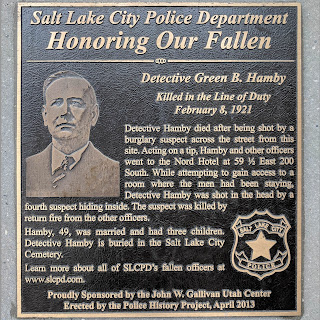
Tom’s gang immediately confessed, and the police soon raided the Nord Hotel looking for Tom. During the raid, Tom shot and killed SLC Police Detective Green Hamby and wounded Chief of Police Joseph E. Burbidge. Burbidge then shot Tom in the chest who died an hour later at the hospital. You can find a memorial plaque for Detective Green at the Gallivan Center.

No one claimed Tom’s body, so it was sent to the University of Utah Medical School for dissection and educational purposes.

One version of the removal of Tom’s skin says that it was removed by the university and presented to the police who then hung it on the wall in the evidence room.

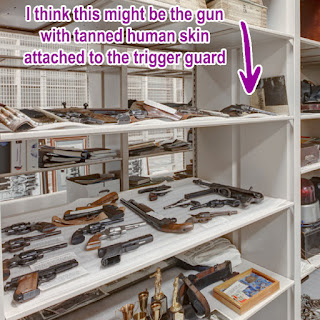
Another version says that off-duty police officers snuck into the police morgue and removed the skin, tanned it, and then looped it on the trigger guard of the pistol Tom had used to kill Hamby and wound Burbidge.

By 1993 the gun with Tom’s tanned flesh wrapped around the trigger guard was on display at the Police Museum in the old Public Safety Building (315 E 200 South).

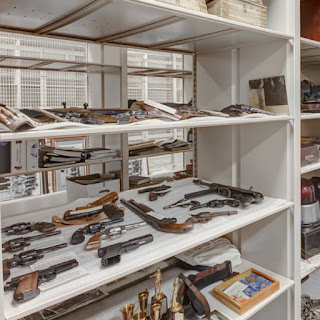
I recently visited the new Police and Fire Museum in the new Public Safety Building (475 S 300 East) and did not see Tom’s skin on display (probably a wise decision). However, I believe a photograph published in 2014 by the SpaceSaver Corporation showing off its museum shelving system does show the notorious flesh-wrapped weapon.

Sources:
Salt Lake Telegram 1921-02-14; SL Telegram 1935-01-05; Deseret News 1993-08-29; End of Watch by Robert Kirby 2004; Case Study: SLC Public Safety Building by SpaceSaver Corp 2014; various vital records on Ancestry

Image showing the SLC Police Museum collections shelving system, from SpaceSaver Corp, 2014

Image showing the SLC Police Museum collections shelving system, SpaceSaver Corp, 2014, with my notes

Tom "Blackie" Burns, real name Joseph C. Alseimer

Memorial plaque for Detective Green G. Hamby, on display at the Gallivan Center, SLC.

23 October 2021

The Witch's House in City Creek Canyon... Is Really the Empire Mill

SLC urban legends tell of the “Witch’s Cabin” (or house or hut) located in City Creek Natural Area above Memory Grove Park (about where 11th Ave would cross City Creek).

Foundation of the Sudbury House (and later Bandstand),
part of the Empire Mill complex, Oct 2021.
 
The tales vary but usually include disembodied lights and voices. Sometimes it is a bad witch, sometimes a good witch, and sometimes the witch turns into a tree. Often the stories get muddled with other tales of Memory Grove.

The actual history is that this stone foundation is the remnants of the Empire Grist Mill complex, specifically the house of Samuel J. Sudbury, the miller employed by Brigham Young.

The Empire Mill was constructed in 1862 by mill architect Frederick Kesler for Brigham Young. Kesler also designed the Chase Mill which was similar in design. Samuel J. Sudbury operated the mill for 17 years for Brigham Young.

The mill’s primary business was to convert tithing wheat (10% of a Mormon farmer’s grain harvest) into flour which was then sold at the Tithing Store on South Temple and Main Street.

The mill was 3 stories tall with a stone foundation and wood frame superstructure. A massive 30 ft diameter waterwheel powered the machinery which produced 100 sacks of flour a day with its 2 pairs of French Burr grinding stones. The adjacent house was occupied by the Sudbury family and had a large garden and orchard.

On May 22, 1883, the mill burned to the ground destroying the mill and $8K of wheat and flour (~$217K today). The equipment that could be salvaged, including the millstones, were relocated to the Chase Mill, which is now in Liberty Park.

In 1902 Salt Lake City purchased the upper part of City Creek Canyon from the family of Brigham Young, which included the ruins of the Empire Mill and Sudbury House. In 1913, the SLC chain gang demolished the remaining walls of the mill complex.

In 1914 the SLC Parks Department built a new bandstand on the foundation of the old house as part of the grand opening of the new City Creek Boulevard (now North Canyon Road) and the construction of a footpath up the canyon (now the Freedom Trail).

The building of the bandstand explains the current configuration of the ruins: the concrete capped walls and stairs, the stone pillars along the walls, steel posts within the pillars, and entrances on all 4 sides of the foundation.

Throughout the 1920s the ruins of the old mill, by then mostly known as Sudbury’s Mill or Sudbury’s Flat, was a popular spot for picnics.

From what I could determine, by the 1970s memory of the old Empire Mill and house had been mostly forgotten and the urban legends of hauntings became more prevalent.

In fact, in a Facebook post on Utah’s Haunted History, Meretta England says that in 1976 she and her friends haunted Memory Grove as a prank and are responsible for the Ghost Bride stories.

NOTE 1:
If you are interested in the paranormal aspect of this area I found that The Ghost Box podcast Episode 2 “Memory Grove Never Forgets” was a good balance between the skeptic and the believer. 

NOTE 2:
The ruins of the old Empire Mill are located on land owned and administered by Salt Lake City and is within the City Creek National Historic District and the local City Creek Local Historic District. This means that the Salt Lake City government (and the SLC Historic Landmarks Commission) is responsible for the oversight, preservation, and interpretation of this site.


Sources:
Deseret News 1883-05-23; Salt Lake Tribune 1891-07-19; Salt Lake Herald 1913-07-27; Deseret News 1914-04-29; Salt Lake Tribune 1920-04-30; Salt Lake Tribune 1921-06-12; Salt Lake Tribune 1925-05-10; UDSH Liberty Park site file; SLC Plat D; Utah’s Haunted History Memory Grove thread 2020-05-17.

Foundation of the Sudbury House (and later Bandstand),
part of the Empire Mill complex, Oct 2021.

Foundation of the Sudbury House (and later Bandstand),
part of the Empire Mill complex, Oct 2021.

Detail of foundation walls. Note the concrete cap and steel pipe post. 

Composite image of Empire Mill photograph and SLC Plat D Map, both from UDSH

Colorized photo of Empire Mill with labeled notes.
Composite image of Empire Mill plans, from UDSH.

20 October 2021

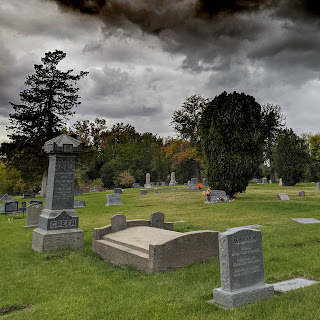
Murray City Cemetery's Unusual Bedstone

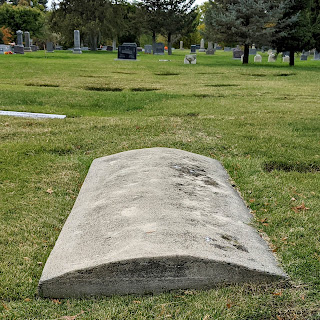
Alvin and Francis Green's grave cover in the shape of a bed,
on a stormy day in Murray City Cemetery, 2021

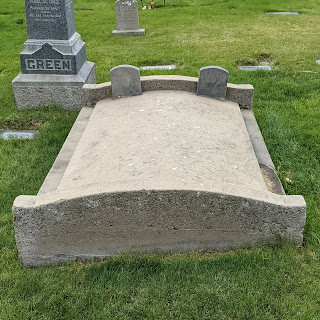
Murray City Cemetery is home to a few oddities, one of which is this concrete grave cover in the shape of a bed that marks the graves of Alvin G. and Francis Green.

The Greens were early settlers of Murray, with their family home located just east of what is now I-15 and 5300 South. Green Street is named after the family and the irrigation canal they built, the Green Ditch.

Alvin died in 1912 and his wife Francis died in 1913. They were both buried in an underground crypt with stairs leading down to doors. This style of underground crypt is not common in Utah, but Alvin was from New York and Frances (who probably arranged the burial site) was from Mississippi, where these crypts are more common. The stairs were probably at the head or the foot of the crypt as those adjacent grave spaces were empty until the 1930s and 1940s.

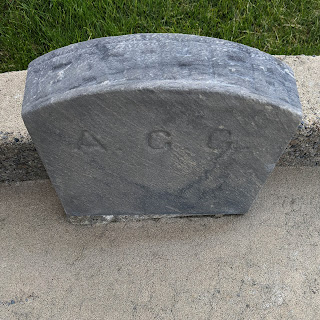
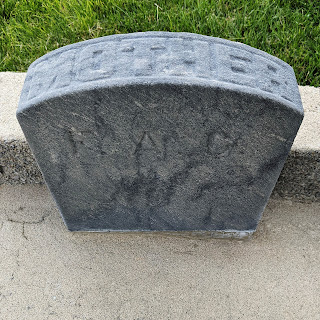
At some point (1930s or 1940s is my guess), the open hole created by the stairs was determined to be a safety hazard and was filled in and the crypt capped with concrete in the shape of the bed. Headstones with the initials of Alvin and Frances were placed like pillows on the bed.

Although this odd feature of Murray City Cemetery tends to get quite a bit of attention it is not the only grave cover in the cemetery. There is a less conspicuous concrete cover marking the graves of Franklin and Elizabeth Webb who were buried in the 1920s.

Alvin and Francis Green's grave cover.

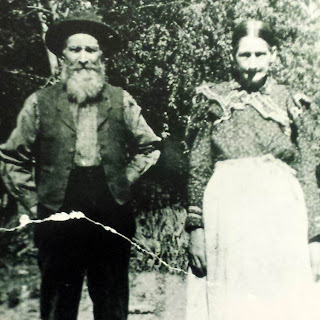
"Father" "A. G. C."

"Mother" "F. A. G."

Alvin G. and Francis Alice Green, from FamilySearch

The less conspicuous grave cover for
Franklin and Elizabeth Webb, Murray City Cemetery, 2021

15 October 2021

SLC Council Candidates and their Views on Historic Preservation

SLC Council Ballots have gone out, so I thought I would gather some publicly available data for your consideration. No spooky stories today.
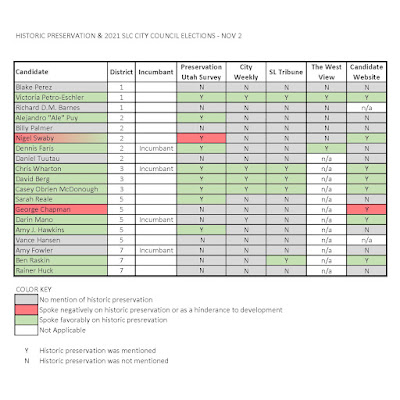
Chart of Salt Lake City Council candidates (2021)
and their views on historic preservation. 

A couple of years back a volunteer door-to-door campaign supporter for the SLC mayoral election asked me about the local issues important to me and I answered I was concerned with historic preservation. Her response was “I’ve never heard anything about that.”

I would hope that in the last 2 years that at least some of the candidates would take notice of the increased demolition of historic spaces.

This simple analysis clearly does not take into account the multitude of issues facing SLC. Candidates and voters value certain issues over others and decisions are made with those trade-offs in mind.

However, I do believe that historic preservation is intertwined with many of the most pressing issues facing SLC government such as housing affordability, distribution of density, homelessness, open/green space, sustainable growth, and environmental sustainability.

This chart is compiled from publicly available sources and shows which candidates acknowledge historic preservation as an issue. To receive a “Yes” the candidate needed to specifically mention historic spaces or preservation, not simply a vague characterization of preserving neighborhood character as that is too open to interpretation.

You can judge for yourself the effectiveness/sincerity/value of their approaches and their record on the issue.
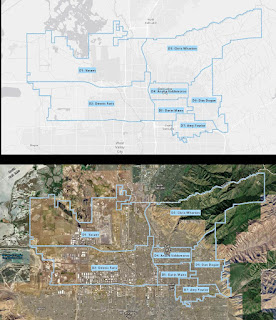
SLC Council District Maps