Showing posts with label Murray. Show all posts

20 October 2021

Murray City Cemetery's Unusual Bedstone

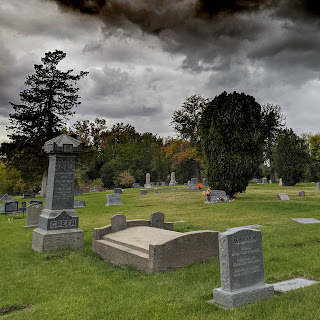
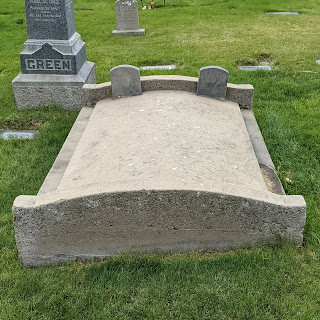
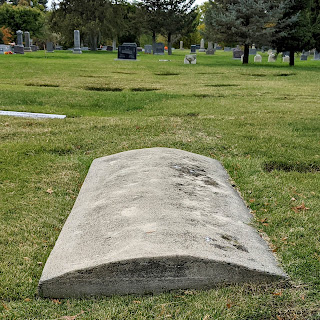
Alvin and Francis Green's grave cover in the shape of a bed,
on a stormy day in Murray City Cemetery, 2021

Murray City Cemetery is home to a few oddities, one of which is this concrete grave cover in the shape of a bed that marks the graves of Alvin G. and Francis Green.

The Greens were early settlers of Murray, with their family home located just east of what is now I-15 and 5300 South. Green Street is named after the family and the irrigation canal they built, the Green Ditch.

Alvin died in 1912 and his wife Francis died in 1913. They were both buried in an underground crypt with stairs leading down to doors. This style of underground crypt is not common in Utah, but Alvin was from New York and Frances (who probably arranged the burial site) was from Mississippi, where these crypts are more common. The stairs were probably at the head or the foot of the crypt as those adjacent grave spaces were empty until the 1930s and 1940s.

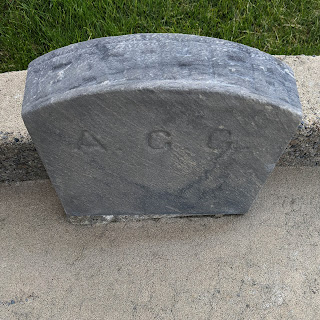
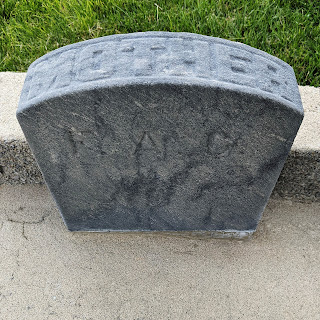
At some point (1930s or 1940s is my guess), the open hole created by the stairs was determined to be a safety hazard and was filled in and the crypt capped with concrete in the shape of the bed. Headstones with the initials of Alvin and Frances were placed like pillows on the bed.

Although this odd feature of Murray City Cemetery tends to get quite a bit of attention it is not the only grave cover in the cemetery. There is a less conspicuous concrete cover marking the graves of Franklin and Elizabeth Webb who were buried in the 1920s.

Alvin and Francis Green's grave cover.

"Father" "A. G. C."

"Mother" "F. A. G."

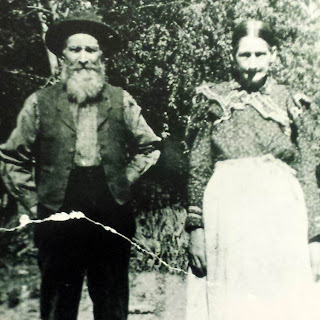
Alvin G. and Francis Alice Green, from FamilySearch

The less conspicuous grave cover for
Franklin and Elizabeth Webb, Murray City Cemetery, 2021

12 October 2021

A 1904 Ghost story at Murray City Cemetery

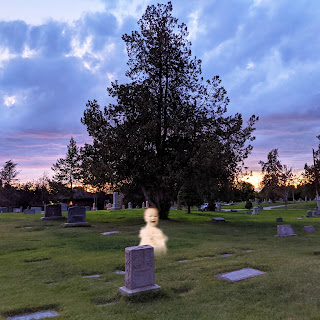
An (obvious) photoshopped image of
Murray City Cemetery and baby ghost Calvin.
Ghost stories are plentiful at Murray City Cemetery and one of the earliest is from 1904.

According to a story in the Salt Lake Tribune, a young man took a shortcut through the Murray City Cemetery to visit a young lady he fancied.

On this Wednesday night (April 27, 1904) the young man reached the middle of the cemetery and encountered a white figure that slowly emerged from the ground and hung suspended over a grave. He distinguished the outline of a small child. As he continued to gaze in fright the figure slowly disappeared sinking back into the earth.

He walked a few more paces and the ghostly figure again rose and hovered above the surface of the ground. Again, the young man stopped and again the ghost vanished. This repeated a third time at which point he turned back and fled without another look!

The Tribune’s report continues stating that Cemetery Sexton Robert Wright spoiled the ghost story. Sexton Wright said that he was digging a grave that Wednesday night that needed to be ready the next morning, April 28th. The grave was half dug when he heard a noise, so he raised his head and looked around. It was so dark he could not see anything, so he went back to digging. This happened 2 more times and then he saw a man running down the path as hard as he could go.

A few days later the Deseret News took issue with the Tribune’s reporting stating that Sexton Wright was not digging a grave that night and that there were no rumors of ghosts in the cemetery. If the Deseret News reporting is accurate and Sexton Wright was not present, perhaps the young man really did see a ghost.

In attempting to fact-check this story I found a close match to the young man’s ghost story: Two-year-old Calvin Wilson died of diphtheria on April 26, 1904 and was buried in Murray City Cemetery the following day, April 27.

The burial is one day off from the young man’s story but perhaps he misremembered the exact day. Regardless, it is a good ghost story.

Murray City Cemetery at sunset, 2021.
Family photo of baby Calvin Wilson and grandmother
Lillie Archer Wilson, from FamilySearch
Gravesite of baby Calvin Wilson, 2014 from FindAGrave

18 August 2021

Kiha Ka’awa Nebeker, one of the first Native Hawaiians in Utah and the US

Kiha Ka’awa Nebek.
Image from FindAGrave
Kiha Ka’awa Nebeker was one of the first Native Hawaiians to permanently immigrate from the Sandwich Islands (now known as Hawaii) to the US mainland.

Kiha came to SLC as an 11-year-old child in 1873 along with 2 other children from Hawaii: Kahana Pukahi and Charles Rowan. Kahana was also a Native Hawaiian and Charles, although born in Hawaii, was of English-American descent. 

All 3 children were part of families that had converted to Mormonism and received permission from King Kalakaua to leave Hawaii with the Mormon missionaries. Kahana and Charles lived with William King in Fillmore and Kiha lived with George Nebeker in SLC.

Kiha was adopted by George Nebeker and his 2nd polygamous wife, Maria. Sometimes the term “adopted” can be ambiguous but in this case it seems to be a legitimate integration into the Nebeker family and Kiha used the Nebeker name for the rest of his life.

While growing up in SLC during the 1870s, Kiha lived with the Nebekers in an adobe home located at what is now 344 N 500 West (now occupied by railroad tracks). At the time this area of SLC was very rural with few homes and primarily farmland.

In 1885 Kiha married Emma Weinauge, a White woman who was also a Mormon convert.

In Feb 1886 Kiha became a legal US citizen (likely the first Hawaiian to become a citizen).

Both these dates are important because in 1888 Utah passed an anti-miscegenation law banning interracial marriage and in 1889 the Utah Supreme Court banned Native Hawaiians from becoming citizens of the US and legally defined them as belonging to the Malay race.

Emma and their 2nd child both died in 1890 leaving Kiha a single father of a baby boy, Orson.

Kiha remarried about 1900 to a SLC woman of Irish decent, Mattie Graham. The marriage took place in Evanston because Wyoming had repealed its interracial marriage law in 1882 (reinstated 1913).

Kiha and Mattie raised Orson and 4 daughters in SLC. They lived in several different neighborhoods including Millcreek, Murray, and West Temple before moving to what is now the Central 9th area.

In 1919 they rented a house at 809 S Jefferson and lived there until 1921. Until recently, this was the only home of Kiha’s that had not been demolished (Image 3).

In 1925, Kiha and Mattie purchased a house at 154 W 700 South (now demolished). It was the first home that Kiha owned and he was 63 years old when he moved in. 

Kiha died in 1931 at the age of 69 of Pulmanary Tuberculosis. His wife, Mattie, continued to live in their house until her death in 1963.

Kiha Ka'awa Nebeker's house at
809 S Jefferson SLC, June 23 2021.

809 S Jefferson SLC, demolished. Aug 13 2021.

26 July 2020

Hate Crime in Murray in 1922: Jim Bing

4863 South State, Desert Star Playhouse, constructed in 1930.
This building replaced the one at which this incident occurred.
On the night of March 30, 1922, a group of White men terrorized the only Black man living in Murray, Jim Bing. The ordeal started at the location that is now the Desert Star Playhouse..
This is one of the stories documented in the book Blazing Crosses in Zion.

In 1922 the Ku Klux Klan had started to publicly recruit for members in SLC and the surrounding communities. The aura of mystery around the KKK prompted several local incidents that were never tied to official KKK activities.

Jim Bing was an honorably discharged veteran of WWI who had just moved to Murray from the Pacific Coast and started working as a bootblack (shoe shiner) for Joseph Chivrell at his store, Champion Shoe Repair, at 4863 South State Street.

Three Murray men, George B. Studham (1896-1949), J. Eugene Bringhurst (1901-1961), and Amos Jensen (1900-1948), “rigged themselves up in ghostly attire” and burst in upon Mr. Bing while he was sleeping in the rear of the store.

Bing initially fled but was captured, “severely beaten,” and then taken by automobile (probably Studham’s car since he had one and was a chauffeur) to Murray City Cemetery where he was further tormented by being forced to “offer up prayers for his ancestors” while “kneeling upon a grave with his hands clasped around a tombstone.” The men also threated Bing with a coat of tar and feathers if he reported the incident.

The next morning Bing’s face showed signs of a beating and his neck was so swollen that he could not swallow. Two days later, on April 2, Bing disappeared leaving all his belongings in the back of Chivrell’s shop.

On the complaint of Bing’s employer, Joseph Chivrell, the three men were arrested and charged with assault and battery. But without Mr. Bing to testify against them the charges were ultimately dropped.

Sources: Blazing Crosses in Zion by Larry Gerlach p34-35; SL Trib 1922-04-15; SL Telegram 1922-04-14 & 1922-05-02

Note: I looked for Jim Bing in the historic records but could not find any other info on him. Unfortunately I am not convinced the local papers that reported the incident even got his name correct (they misspelled nearly everyone else's involved as well). I could not find a Jim Bing WWI vet that was a Black man that ever left the South. His name could have easily been King or Binge or something else just one letter off. I do hope he made it out if town alive.

11 April 2020

Taijiro Kasuga: SLC Strawberry King

 Taijiro Kasuga from UDSH.
Colorization by MyHeritage
Inspired by TigerKing, I’m going to highlight some of the Kings of Salt Lake City.

First up is the Strawberry King: Mr. Taijiro Kasuga. 

Taijiro Kasuga was a Japanese immigrant who developed and patented a new variety of strawberry in 1926.

Tijiro Kasuga immigrated to the United States from Japan in 1895 and came to Utah in 1901. A believer in luck and that someone was looking after him, Kasuga worked as a cook at a mining camp in Alta in 1909 when he got into an argument with his boss and quit; a week later, an avalanche buried the camp and killed the new cook in his cabin.

Kasuga turned to farming, especially strawberries. He and his family tried several locations: Butlerville (now Cottonwood Heights), Murray, Granite, and Union (now Ft Union). Kasuga’s had difficulty farming in Butlerville and Murray due to drought, early frost, and alkaline soil; his attempts to farm strawberries in Granite and later in Union thrived.

After 10 years of experimenting Kasuga developed his own variety of strawberry by crossing the Berri-Supreme with the Rockhill; he named it the Twentieth Century Everlasting. The Century was highly favorable, prolific, and stayed fresh during shipping. Kasuga patented it in 1926 and made it available to commercial growers in 1932.

In 1940, the Century became highly publicized as one of the best strawberry varieties available. Unfortunately, soon thereafter the US became involved with WWII and sentiments toward Japanese living in the US turned suspect. 

The Kasuga family became a victim of this mistrust, especially since their farm at the mouth of Little Cottonwood Canyon contained an open pipeline with access to Sandy City’s water source. Many neighbors felt that the Kasuga’s would sabotage the water system and pressured Kasuga's landlord to evict him but the landlord felt Kasuga was an honorable man and that he would not be evicted.  After the war, the Kasuga family settled in Sandy.

Although the Twentieth Century strawberry is no longer common its descendant the Ozark Beauty is. The Ozark Beauty variety is a crossbred of the Twentieth Century and the Red Rich varieties and is one of the most common strawberry varieties available to Salt Lake City home gardeners.

Update May 17 2021:
Check out this SLC History Minute on Taijiro Kasuga.

14 July 2019

James and Mary Jane Gardner Miller House in Murray

The historic James and Mary Jane Gardner Miller House once sat on a 160-acre homestead but now lays hidden within an apartment complex in Murray, Utah. It was built in two phases between 1865 (adobe house) and 1882 (Victorian-style house- most of what remains today). The Miller House is significant as one of only five known extant homes built during the homesteading period of Murray's history.

James Miller began farming the homestead in 1859, but was also a prominent merchant in farm implements. Mary Jane Miller raised silk worms and contributed to the pioneer silk industry in Utah.

The farmstead included a flour mill where hundreds of residents from neighboring communities came to grind their wheat. Two mill stones were found in the pond during the construction of the apartments; one is now installed as a monument near the house and the other is believed to be on display at the Gardner Mill in West Jordan.

On the interior, the Miller House has an exceptionally rare collection of 19th-century interior murals with scenes of the pioneer era including line-drawn scenes of a cattle roundup, a farmer plowing, a cowboy, and a landscape of what appears to be the former Mormon settlement of Nauvoo, Illinois.

The historic address of the home was 864 East 4800 South but is now known as 4929 S. Lake Pines Drive, Murray, and is located just off the Van Winkle Expressway.

Thanks to the Murray City Museum for helping me track down this information! Source: Miller House NRHP Nomination site form.

Note: Although this house was submitted for listing on the National Register of Historic Places, it was determined to not be eligible for listing on the National Register because of recent alterations.


04 July 2018

Now & Then: Salt Lake County Fire Station at 4735 S State

Then and Now: The old Salt Lake County Fire Station at 4735 S State Street in Murray Utah. 

Part of this building was constructed in the 1890s by the J.A. Jones Planning Mill. Salt Lake County bought it in 1915 and converted it into a repair shop for county vehicles, a county fire station and Firemen's Hall. 

Now it is a BMW sales shop. 

The historic image is from Murray City Museum and is undated.

The modern images were taken June 29 2018.


24 April 2013

Bennion Flour and Feed Mill in Murray

Just a quick snapshot of what is currently known as the Silver Cup factory in Murray at 118 W 4800 South. It was built in 1909 and was originally the Bennion Flour and Feed Mill.

Update: A fire burned this structure in 2015, here is a Salt Lake Tribune article on it.