Showing posts with label Now Demolished. Show all posts

04 July 2026

Flag Wars (size matters)

Fifty years ago the USA Bicentennial celebration prompted competition among several Utah businesses to have the biggest American flag or the tallest flagpole.

Plaque and flag at Free Spirit Plaza, 2280 S State Street SLC

It began in Feb 1976 when Hayes Brothers car dealership announced the grand opening of the Free Spirit Plaza at 2280 South State Street.

Hayes Brothers claimed "the tallest flagpole in the State of Utah" at 200 feet, although later sources reported shorter measurements. State, county, and city officials joined the Utah National Guard and the Utah Bicentennial Committee for the Flag Day dedication.

Hays Brothers advertisement
Deseret News Feb 17 1976 p36
 
The flagpole and commemorative plaque still stand at Free Spirit Plaza, now home to Tesla.

Over the next few decades, shopping centers, businesses, and civic organizations across Utah promoted their own largest flags or tallest flagpoles. Some of these include Valley Fair Mall, Layton Hills Mall, Van Winkle, Reams in Provo, the State Capitol Building, among others.

Lincoln Plaza at 145 E 1300 South SLC

By 1990, Lincoln Plaza at 145 E 1300 S (demolished Sept 2026) entered the competition with a 38×20-foot flag on a 120-foot pole. The SL Tribune noted it was Salt Lake County's third oversized flag, comparing it directly with Hayes Brothers and the Van Winkle Expressway display.

Utah's tradition of giant flags stretched back even earlier. In 1896, an enormous American flag was hung from the ceiling in the Salt Lake Tabernacle. In 1897 this flag was moved and hung on the south side of the SLC LDS Temple for the 50th anniversary celebration of July 24.

The measurements of this flag vary widely depending on the source. Newspaper articles from 1896 describe the flag as 150×75 or 125×75. Later sources in 1897 and 1901 indicate larger and smaller measurements.

Statehood Celebration 1896, from USHS
Newspaper clip from Woman's Exponent Jan 1 1896 p4

Commemoration of Utah statehood, 1896, SLC LDS Temple
From USHS

Today, enormous ceremonial flags such as Big Betsy in Grove Canyon continue that tradition.

Other claims through the years:
  • 1977: Reams Market at 1350 N 200 W in Provo claimed the tallest flagpole in the state at 160 ft.
  • 1978: Valley Fair Mall in West Valley City : largest flag in the world (no dimensions given)
  • 1980: Layton Hills Mall in Layton: largest flag in the state (no dimensions given)
  • 1988: Spring Run, along VanWinkle Expressway in Murray: largest flag in the state at 60x30 ft with the second tallest pole at 110 ft.
  • 1988 Utah Summer Games in Cedar City: Largest flag in the state, 150x75
  • 1992: Franklin Quest Corp in West Valley City: tallest flagpole in the state at 120 ft with 50x30 size flag.
  • 1993: Utah Summer Games in Cedar City: Largest flag in the state 108x65 ft
  • 1998: Reams Market in Provo, largest flag in the state along with the largest pair of pants (no dimensions given)
  • 2001: Utah State Capitol Building in SLC: One of the world’s largest (no dimensions given)
  • 2001: Stadium of Fire event at LaVell Edwards Stadium in Provo: largest flag in the state (no dimensions given)
  • 2002: Freedom Festival in Provo Utah: : largest flag in the state (no dimensions given)

Same info as above, just as a table.

Of Note: The Hayes Brothers also advertised a newly constructed natural artesian well drinking fountain for public use. I did not see it during my visit, but perhaps someone knows what happed to it.

14 June 2025

Summer Time is Demolition Time

 Summer is the time for demolitions. Most significantly, the imminent demolition of the historic Phillips Congregational Church near Trolley Square.

Already demolished are the historic Utah Pickle Building and the Christian School.

Thankfully, @artcastleslc saved many sculptures from the Christian School. Be sure to check out some of the large sculptures that are now on the front lawn, 915 W 100 S.


29 March 2025

Utah's First Self-Service Liquor Store on Foothill Boulevard

The old Foothill Utah State Liquor Store at Lamplighter Square at 1615 S Foothill Blvd, Salt Lake City, was Utah’s first self-service liquor store.

Author's photo of the Utah State Liquor Store at 1615 Foothill Blvd, 2021.

The store opened in Feb 1967 and expanded with a front addition in the 1990s. In the photograph above  you can see part of the old-mid century modern design from the original building.

The Foothill store was different from others operating at the time as it operated more like a supermarket: customers were able to browse and select the items they wanted and then check out at a cashier stand (as is common now).

Previously, customers asked for their item and a clerk would obtain it for them behind a counter.

The new style of "self-service" store was an instant success. The Utah Liquor Commission quickly opened a second self-service store in Oct 1967 at the Avenues Plaza shopping center. Soon the Murray and Sandy stores converted to self-service as well.

To save on construction costs, the Utah State Prison carpentry shop built all the shelves, counters, turnstiles, and cashiers’ cages for these new self-service stores.

Interior of the SLC Sugar House Liquor Store in 1958 showing items behind the counter
Image from USHS and colorized by Adobe.

Interior of the SLC Foothill Liquor Store in 1967 showing shelves made by prisoners of the Utah State Penitentiary and open browsing aisles. Image from USHS and colorized by Adobe

27 November 2024

The old Diamond Lil's Steakhouse

Diamond Lil's, April 2005. Note "Home Maid"

An old photo of Diamond Lil's. A steakhouse at 1528 W. North Temple. It was destroyed by fire in 2021. I took this photo in 2015.

Here is a short history excerpted from a 2009 Intermountain Catholic article:

In November 1969, Jim Pietramali and Garth Campbell opened Diamond Lil’s doors for business at 1528 West North Temple. The original building was a modest home, which was remodeled using old barn lumber and logs from pioneer cabins, some of which are 100 to 150 years old.

The seating capacity was 32 people in about 1,000 square feet. Today [2009] the seating capacity is 500. The original kitchen was about the size of a large walk-in closet.

Today [2009] Diamond Lil’s is owned by Pete Funaro. He started working at Diamond Lil’s in 1970 for his uncle, Jim Pietramali. Pietramali, 87, still works for Diamond Lil’s.

“A lot of customers kept coming back and we became the premier steak house in Salt Lake City,” said Funaro. “We are an independent Utah’s own company. The seating allows for parties that can seat as many as 275 people at one time.

In 1973, they started adding on to Diamond Lil’s. They used only logs from Utah cabins.

Funaro also has his own wholesale pasta business, Funaro’s Perfect Pasta. Diamond Lil’s serves Funaro’s pasta. All of his pasta was used during the 2002 Winter Olympics in Salt Lake City.

31 October 2024

The Skeleton in Grandpa's Barn


In 1923, a few schoolgirls found a box of human bones in the barn of the Lund family at 127 W. North Temple, Salt Lake City. The box of bones was an open secret known by many of the kids in the neighborhood.

Herbert Z. Lund Jr. recounts the story of these skeletal remains in a Utah Historical Quarterly article titled “The Skeleton in Grandpa’s Barn” (UHQ V35 N1 in 1967).

Herbert Jr. states that his father, Dr. Herbert Z. Lund Sr., was a physician at the Utah State Penitentiary (at what is now Sugar House Park) and acquired the body of J. J. Morris. Morris was executed in 1912 by hanging for murder; and, in accordance with common practice his body was donated for medical purposes.

Dr. Lund intended the body to become a teaching skeletal specimen. After the anatomical dissection was completed, Dr. Lund reduced the body to a skeleton. Part of the process to create a skeletal specimen is maceration so Dr. Lund and his friend William Willis (a druggist by profession) took the remains to an open area near Beck’s Hot Springs and boiled the remains in sulfur water and lime. The final process of bleaching the bones was never completed and the bones retained a rancid odor.

Dr. Lund placed the bones in a wooden box and stored them in the unused hayloft of his father’s barn, Anthon H. Lund’s house at 127 W. North Temple (now demolished).

Dr. Lund’s children (Anthon’s grandchildren) were aware of the skeletal remains and often found ways around the locked entry to view the bones. Even the grandchildren of the adjacent neighbor, LDS apostle Matthias F. Cowley, knew of the bones. So it is not surprising that other kids got into the barn to sneak a peak at the bones of a convicted murderer.

Around 1925, Dr. Lund’s mother, Sarah, demanded that the bones be buried to keep curious people away. Dr. Lund’s son, Herbert Jr, buried the remains behind the old barn. He and his grandmother Sarah had a little graveside service where Sarah read excerpts from the LDS publication “The Improvement Era” and placed the old magazines in the grave with the skeletal remains.

The gravesite was dug behind the barn. Sanborn maps show that this barn was demolished around 1950-1951. In the 1967 article, Herbert Jr. stated that the area of the grave was still open land but that development was happening all around.

Herbert Jr. drew a map of where he believed the gravesite to be. This location is now in an expanded parking lot of the old Travelodge Motel at 144 W. North Temple. It is unknown if construction has impacted the grave or if it is still intact below the asphalt parking lot.


One complication of this story is that there is a burial record for J.J. Morris in the Salt Lake City Cemetery, which contradicts the identity of the skeletal remains as being J.J. Morris. 

However, both the Lund family history and several 1920s newspaper articles (including an interview with Dr. Lund, himself) indicate that the skeleton in Grandpa’s barn is J.J. Morris.

The burial record for J.J. Morris indicates that he is buried along with 14 other prisoners whose remains were originally interred at the old Utah State Penitentiary, which is now Sugar House Park. These remains were disinterred from the Sugar House location in 1957 when the park was built. The remains were reinterred in a small prison cemetery at the Point of the Mountain Prison in Draper. In 1987, the remains were disinterred again and reinterred at the Salt Lake City Cemetery- with several remains (identified as cremains) interred in a single grave.

So if the cemetery record is to be believed (and with all those disinterment’s it is possible that records may have been compromised) then the remains buried behind the Grandpa’s barn are not those of J.J. Morris.

Utah executed several prisoners around the same time as J.J. Morris. It is possible that the identity of the skeleton in Grandpa’s barn is actually that of another prisoner whose remains were also donated to medical science around the same time. Potential candidates for this option include Harry Thorne executed Sept 26 1912 or Frank Romeo executed Feb 20 1913.

Utah Executions 1912-1913

Sources:
  • “The Skeleton in Grandpa’s Barn” UHQ V35 N1,1967
  • Ghosts of West Temple, Salt Lake County Archives
  • "Ray Lund, Prison Doctor" by H Z (Zack) Lund (nd) from FamilySearch
  • Salt Lake Tribune 1923-11-30
  • Deseret News 923-11-30
  • Ogden Standard Examiner 1923-11-30
  • Salt Lake Telegram 1912-05-04
  • Salt Lake Telegram 1912-04-30
  • The Salt Lake Tribune 1980-06-19
  • Various cemetery records from ancestry, names in stone, and find-a-grave

25 September 2024

How did Salt Lake City's 300 South become Broadway?

How did 300 South become Broadway?
Salt Lake City's Broadway (300 South), shown here at the intersection with Shelmerdine Ct (235 East).

In 1912, SLC business owners petitioned the SLC Commission (now City Council) to change the name to highlight the newly developed shopping/business district.

This new 300 South business district was significant in that it was located away from the traditional commercial sectors of Main and State Streets. Many new large department stores had recently been constructed such as Auerbach’s, the Paris, Keith-O’Brien, Walker Bros Dry Goods, and other prominent businesses such as the Judge Building, J G McDonald Chocolate Factory, Peery Hotel, and the Colonial Theater (old Yardstick Building). Many of these buildings are still standing.

Two-page spread in the December 8 1912 edition of the Salt Lake Tribune detailing Broadway shopping between Main and State Streets.

Two-page spread in the December 15 1912 edition of the Salt Lake Tribune detailing Broadway shopping between West Temple and Main Streets.

In May 1912, the Auerbach Company petitioned to rename 300 South, between the Rio Grande Depot and State Street, to Broadway Street- after Broadway in New York City.

Proponents wanted “a distinctive name that commands attention.” They wanted visitors who disembarked a train at the Rio Grande Depot to see a grand boulevard of shops and exquisite buildings, complete with electric streetlights.

There was pushback. Nearly 1,500 Salt Lakers signed a protest against the name change. Many didn’t like the idea of deviating from the SLC’s grid system. Others indicated there was already an alley named Broadway (eventually renamed and is now the northernmost section of Regent Street that runs through City Creek Center). The postal workers were especially against the idea.

I was not able to find any documentation of the official change of name, nor what section was designated as Broadway. I searched various online repositories. Presumably, there is some documentation in the paper records at Salt Lake County archives. Regardless, it seems that maps were eventually updated with the new Broadway Street, although even today maps vary on which section of 300 South is Broadway.

Nowadays, it seems that Salt Lake County retains control of street names. According to their data, Broadway is the section of 300 South between 455 West and 549 East.

The signage of Broadway is a little sporadic. My quick field recon showed that primarily the area between the Rio Grande Depot and State Street is signed as Broadway – except for my photo here at the intersection with Shelmerdine Ct (235 E).

Sources:
Salt Lake Telegram 1912-05-29 Pg 10; 
Salt Lake Tribune 1912-06-18 Pg 6; 
Salt Lake Tribune 1912-07-06 Pg 7; 
Salt Lake Telegram 1912-07-11 Pg 12; 
Salt Lake Tribune 1912-11-10 Pg 20; 
Salt Lake Tribune 1912-11-24 Pg 21; 
SLC Infobase; 
various Sanborn Maps

13 July 2024

Fun photos found in the archive - 1970s

These are fun photos, ca. 1970. This little girl clearly wanted to be part of the archival record, hahaha!

These two houses were at 463 and 467 S. 300 East, respectively. Where the Salt Lake City Public Safety Building is now, east of the Salt Lake City Main (downtown) Library.

These two buildings were likely demolished soon after (a few years?) these photos were taken.

Photos from Utah SHPO building records, here and here.

House at 463 S 300 East, ca 1970s; now demolished.
Image from SHPO historic building files.

Detail of the girl in the above photo.

House at 463 S 300 East, ca 1970s; now demolished.
Image from SHPO historic building files.

Detail of the girl in the above photo.

18 May 2024

Mountainville Academy's Failure to Incorporate STEM Principals into Actual Practice: The Demolition of the Historic Carlisle House

Architectural salvage of the brick from the Fanny and Thomas Carlisle House, May 17 2024. Mountainville Academy will demolish the house for a parking lot and STEM building.

Demolition of the Carlisle House in Alpine has begun. Mountainville Academy (@mountainvilleacademy) refused the offer by Alpine City and the Friends of the Alpine City Library to purchase the property and turn it into a children’s library. As such, Mountainville has decided to demolish the house rather than let someone else buy it to be preserved or to utilize it themselves.

I visited the Thomas and Fanny Carlisle House on Friday, May 17 2024 and took these photographs. The workers in the images were hired by Alpine City (not Mountainville Academy) to conduct architectural salvage; their focus is on recovering the ca1910 brick, which I was told will be repurposed for the Alpine Library.

FOX13's Shanti Lerner reported that Mountainville plans to use the space for a parking lot and a STEM building… both purposes I find enraging. The parking lot is clearly a shortsighted decision and something that could have been designed to easily avoid the Carlisle House.

The lack of integrating the Carlisle House into a STEM building (an addition could have been added) is yet another shortsighted decision and illustrates Mountainville’s lack of creativity and willingness to incorporate the principles of STEM/STEAM into actual practice.

The entire drive back from Alpine all I could do was think of various science, technology, engineering, art, and mathematics classroom exercises that utilized or focused on the Carlisle House. Incorporating historic preservation into STEM/STEAM would have been a true example of “Excellence.”

I helped build Utah’s first standalone STEM program of K-6 grades, at M. Lynn Bennion Elementary (soon to close) a Title 1 School that serves downtown SLC families. We did amazing things with very little funding.

It is so insulting to see a fairly privileged school like Mountainville Academy squander a unique opportunity. One quick example of a potential STEM exercise: make adobe bricks (sun-dried mud) with various compositions and then test their engineering strength.

This potential STEM lesson was on my mind because the adobe brick is now exposed while the exterior fired brick is being salvaged.


31 March 2024

Unauthorized demolition of the historic 5th Ward Meetinghouse on Easter Sunday

5th Ward Meetinghouse, March 31 2024. Photo by author.

Unauthorized demolition of the historic 5th Ward Meetinghouse, 740 S 300 West, Salt Lake City.

Demolition began today, Easter Sunday, (March 31), and today Salt Lake City government issued a stop work order. Most of the building still stands but a portion of the front has been demolished.

To be clear, it was the Salt Lake City government that stopped the demolition. City staff issued the stop work order and I'm being told at least one City Council member is asking for a more extensive review of permits.

There is a bigger issue here: this building is listed as a Local Historic Landmark site. It is also on the National Register of Historic Places, but that designation does not give it any historic protection. It is the Local Register status that gives the building additional zoning (History overlay) that requires a Certificate of Appropriateness and review by the SLC Historic Landmark Commission… which was not done.

All this on Easter weekend.

The building began as an LDS meetinghouse in 1910 but most of its history has been that of a multicultural community building, including that one time the band Nirvana stopped by in 1991 for a little show while it was the Pompadour Rock & Roll Club.

The future of the building is uncertain. Check out this interview I gave with Fox13 Spencer Joseph.

5th Ward Meetinghouse, March 31 2024. Photo by author.

5th Ward Meetinghouse, March 31 2024. Photo by author.

5th Ward Meetinghouse, March 31 2024. Photo by author.

5th Ward Meetinghouse, March 31 2024. Photo by author.

5th Ward Meetinghouse, March 31 2024. Photo by author.

5th Ward Meetinghouse from Google Street View 2021

04 January 2024

2023 Recap with Demolished Salt Lake Podcast

I was a guest on episodes 31 and 32 of the Demolished Salt Lake Podcast. “2023 Preservation Wins, Loses and What to Watch in 2024.”

We discussed some of the buildings we lost in 2023, the ones that were saved, and those that are in danger of demolition in 2024. We had more saves than losses this year, which was greatly needed after the past few years.

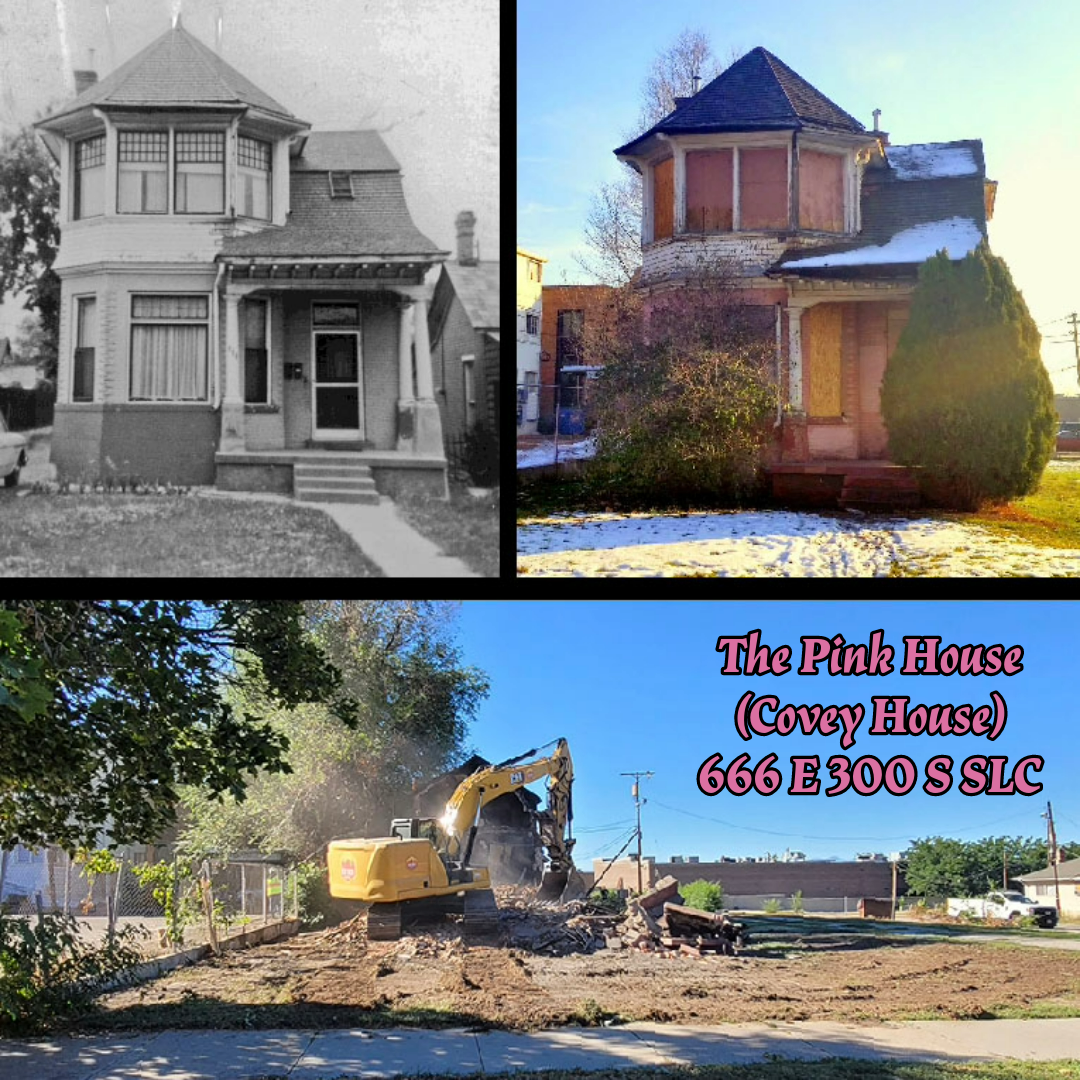
In this first of two parts, we talk about the loss of the Pink House and the Yardstick Building earlier this year. Discuss the status of the land on which some historic buildings used to stand in my “Still a Parking Lot” segment (ahem... the La France Apartments) and move on to buildings that will be demolished in 2024. Saving the best for last, we end with good news for a few of our historic buildings and areas.

We know we missed some buildings, but these are some of the standouts.

With – Wendi Pettett and Chris Jensen of Demolished Salt Lake Podcast and Adrienne White of House Genealogy

Photos of some of the highlights:

1. The Pink House (Covey House), 666 E 300 South SLC
2. Mountain Bell Building, 205 E 200 South SLC
3. Elias Harrison House, 10 N 300 West SLC
4. Cramer House, 241 Floral St SLC
5. Liberty Wells Center, 707 S 400 East SLC
6. Musser House, 2157 S Lincoln St SLC
7. 2nd Ward Assembly Hall, 483 E 700 South SLC
8. Jerald and Sandra Tanner House / Utah Lighthouse Ministries, 1350-1358 S West Temple SLC
9. Brinton House, 4880 S Highland Circle Holladay
10. Wells Ward Chapel, 1990 S 500 East SLC