Showing posts with label WWII. Show all posts

12 October 2024

Historic Intermountain Casket Building at 276 W 100 South

Intermountain Casket Co. building, constructed by the Villadsen Brothers, 1920.
Located at 276 West 100 South, Salt Lake City. Image from USHS.

The historic Intermountain Casket Building (aka Struve Distribution Building) at 276 W 100 South, in Salt Lake's Japantown, was built in 1920.

As discussed in my previous post about the Midwest Casket Building, several casket manufacturers were in Salt Lake City during the 1910s and1920s and one of them was the Intermountain Casket Company.

Intermountain Casket Company building, 2024.
Located at 276 West 100 South, Salt Lake City. 

Intermountain Casket was founded in 1919 by Alma O. Taylor (son of “Pioneer Undertaker” Joseph E. Taylor) and Lafayette Holbrook (quite wealthy from mining and commercial endeavors, former mayor of Provo, and well-connected political and religious relationships).

Alma split from his brothers Samuel and Joseph W. Taylor’s Salt Lake Casket Company and formed his own competing operation. There must have been some Taylor family drama there, especially factoring in that "Pioneer Undertaker" Joseph E. Taylor practiced polygamy, which meant that Joseph W. was the first-born of the first wife and half-brother to Samuel and Alma who were both from the third wife.

As a new company, Intermountain Casket built a new and modern 3-story factory at the corner of 100 South and 300 West. Construction started in 1919 and it opened in January 1920. 

As an aside- The property of the Intermountain Casket Company building was purchased from Annette “Nettie” Eliza Amussen Evans, who inherited it from her father Carl Christian Amussen who was an early Mormon Pioneer, Utah’s first jeweler and wo built the Amussen Building originally located at 62 S Main Street in 1869. The facade of the Amussen Building was relocated during the construction of City Creek Center and is now within a pedestrian walkway south of Deseret Book at about 45 W South Temple.

 I mention this because I wondered why Intermountain Casket built in SLC's Japantown, which would have been very active in the 1920s and Intermountain Casket (unlike the Midwest Casket Co) seemed heavily affiliated with the LDS religion, so it seemed an odd choice of location. However, it seems as simple as it was a large lot with a small adobe home owned by a Mormon pioneer family; the adobe house was being rented out and, like today, a large lot was more valuable for building upon so it was available for purchase. The lot was split with the Intermountain Casket Co building on the west half at 276 W. 100 S. in 1920 and the Japanese Church of Christ building on east half at 268 W. 100 S. in 1924. 

Japanese Church of Christ adjacent to the Intermountain Casket Company (note sign).
Unknown date.  Image from USHS.

The 3-story Intermountain Casket building was constructed by the Villadsen Brothers, who had recently opened an office in Salt Lake City. The Villadsen Brothers were authorities on reinforced concrete and one of the biggest general contractors in the Western US. They also built the Ford Motor Company Service Building at 280 S. 400 West and the Continental Bank Building (Hotel Monaco) at 15 W 200 South, Salt Lake City. 

Villadsen Brothers advertisement. Deseret News 1920-07-12 p11.

The Intermountain Casket building is made of reinforced concrete frame and brick infill that was popular around the time of WWI. The insignia of the Intermountain Casket Company “cIc” can still be seen on the second level of the façade along 100 South.

Intermountain Casket Company insignia "cIc"

Intermountain was described as having “the finest casket display rooms west of Chicago.” They were a wholesale company supplying Utah, Colorado, Idaho, Wyoming, and Nevada.

In 1924, Intermountain Casket supplied 120 caskets for the victims of the Castle Gate Mine Disaster near Price, Utah.
Mass burial services for some of the Greek immigrants killed during the Castle Gate Mine explosion in 1924. Held in a hall at Castle Gate. Caskets supplied by Intermountain Casket Company in Salt Lake City.  Image from USHS.

Intermountain Casket closed business in 1943 with the company’s president Alma O. Taylor saying that WWII wartime restrictions had become too severe to manufacture caskets as ordered. He was quoted as saying “production of metal caskets and handles were ordered stopped by the war production board, a 50% reduction on silk for trimming was ordered, then the length was reduced, then came the limitation of styles, and with no priorities what can one do?”

These wartime restrictions were ordered by the War Production Board and included an order that steel could not be used for caskets so manufacturers switched to wood and concrete. I also found reference to “Order L-34 (caskets, shipping cases, and burial vaults)” which mandated reduction of length of certain percentage of caskets.

Consolidated Amusement purchased the building in 1943 and in addition to its own offices it also provided office space to a variety of other businesses.  Consolidated Amusement was known for jukeboxes. 

Consolidated Amusement 1945. Interior of the Intermountain Casket building.
Image from USHS.

The building in 1945, when it was the Consolidated Amusement Company.
Located at 276 West 100 South, Salt Lake City. Image from USHS.

Intermountain Casket Company building, 2024.
Located at 276 West 100 South, Salt Lake City. 

Struve Distributing Company purchased the building in 1966. They were known for pool tables, billiard supplies, and other amusement and tavern equipment. They closed 2011.

Struve Distributing Company advertising home pool tables.
From The Salt Lake Tribune 1967-12-16 p35. 

Struve Distributing Company advertising Elton John's Capt. Fantastic pinball machine.
From Marketplace Issue July 04 1976 (from International Arcade Museum)

Some comments on my Instagram post made reference to Real Ride Skatepark using the interior of the building (and all that concrete!) as a (private?) skatepark.   

Interior of the Intermountain Casket Company building, from LoopNet.

Interior of the Intermountain Casket Company building, from LoopNet.

Interior of the Intermountain Casket Company building, from LoopNet.

Currently the building is available for lease. It is located just east of the Delta Center and although not specifically identified for redevelopment, it is within the general area of the Smith Entertainment Group (SEG) redevelopment project.

Location of the building relevant to Japantown and Delta Center.

Sources:

  • Goodwins Weekly 1924-08-23 p30
  • Salt Lake Herald 1919-07-13 p23
  • Salt Lake Herald 1919-06-11 p14
  • SL Herald 1916-06-12 p7
  • Salt Lake Herald 1919-07-13 p29
  • Salt Lake Telegram 1924-03-10 p3
  • Salt Lake Tribune 1943-02-11 p12
  • 276 W 100 S USHS file
  • Various Sanborn maps and FamilySearch data

07 December 2021

USS Utah: The Forgotten Ship of Pearl Harbor

Today, Dec 7 2021, is the 80th anniversary of the Japanese attack on Pearl Harbor.

One of the losses of the attack on Pearl Harbor was the battleship USS Utah, now often referred to as “The Forgotten Ship of Pearl Harbor.”  

The USS Utah at Pearl Harbor as it appears today. From ussutah1941.org

The USS Utah was launched on Dec 23 1909 with Utah Governor William Spry’s daughter, Mary Alice Spry breaking a bottle of champaign on the ship’s bow. At the time of its launch it was the largest vessel in the US Navy. In 1932 the Utah was converted for use as a target and training ship.

USS Utah in 1913. From US Navy History and Heritage Command

On Dec 7, 1941, the Utah was moored off Ford Island in the center of Pearl Harbor. The attack on the fleet at Pearl Harbor began at 7:55 am and lasted about 2 hours, but for Utah it was over in a few minutes.

At 8:01 am the ship was hit by the first of two torpedoes and immediately started to list to port (left side of the ship). At 08:12 am, the mooring lines snapped causing the Utah to completely capsize.

The crew abandoned the ship. Most sailors were stationed below deck and they quickly headed topside. There are many heroic stories of sailors helping with the evacuation such as Chief Peter Tomich who remained at his post in the engineering section until he saw that all boilers were secure and all men were evacuated, even at the cost of his own life. Tomich posthumously received the Medal of Honor for his actions.

Fireman 2nd Class John B. Vaessen also remained at his post in the electrical room making sure that the ship had enough power to keep the lights to aid in the evacuation process. After the ship capsized, Veassan was trapped for 2 days in the overturned hull of the ship. For those 2 days he tapped on the hull hoping for rescue. Machinist S.A. Szymanski and other men from the neighboring USS Raleigh were able to cut through the hull of the Utah and rescue Vaessen. The Navy Cross was awarded to Vaessen for his actions. He died in 2018.

 Rescue and recovery efforts at USS Utah, Dec 1941. From ussutah1941.org

Altogether, 30 officers and 431 enlisted men of the USS Utah survived the attack and 6 officers and 52 enlisted men died. Only the remains of 4 men were recovered and interred ashore leaving 54 sailors still entombed within the Utah.

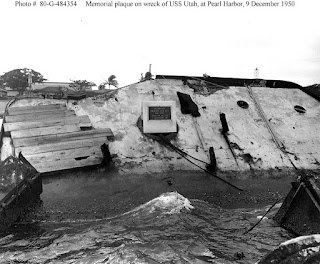
As the ship had little military value no effort was made to refloat it. A small monument is present at the site of the USS Utah on the opposite side of Ford Island from the USS Arizona. Of the several battleships sunk in the attack on Pearl Harbor, only the USS Arizona and the USS Utah remain.

USS Utah Memorial in 1950, From US Navy History and Heritage Command

Sources:

02 September 2021

Adaptive Reuse Planned for the University of Utah's Historic Fieldhouse

Einar Nielsen Fieldhouse at the
University of Utah, Sept 2021

A good news post! 

Recently the University of Utah announced that it will be turning the historic Einar Nielsen Fieldhouse into a 375-seat state-of-the-art theatre.

A seismic renovation has recently been completed and some new paint has been applied to the rooftop letters. A gift from the Meldrum Foundation will transform the space so it can be utilized by the Department of Theatre and Pioneer Theatre Company.

The fieldhouse was designed by prominent local architecture firm Ashton and Evans and built in 1939 by contractors George A. Whitmeyer & Sons. It was partially paid by a grant from the Public Works Administration.

When it opened it was known as the Ute Fieldhouse and was the largest building on campus with a seating capacity of 4,000. Basketball games and physical fitness exercises were the principle uses of the building. It was renamed in honor of Einar Nielsen in 1954 in recognition of his 40 years of service as the U’s athletic trainer.

During WWII, the fieldhouse was converted for use as a massive dormitory for military personnel who were receiving medical training at the University of Utah. The bleachers, basketball standards, and basketball floor were removed and stored in the balcony and new oak tongue and groove flooring was installed. The bathrooms were expanded and a post office, officers’ quarters, barber shop, and a lounge were installed in the balcony.

After WWII the fieldhouse was the home venue of Ute basketball.

Sources: UofU Finer Points Blog Aug 18 2021; UofU Historic Buildings Einar Nielsen Fieldhouse; SL Trib 1954-06-27

Einar Nielsen Fieldhouse at the
University of Utah, Sept 2021

Architectural plan composite for the fieldhouse,
top from SL Trib 1938-07-07;
bottom from SL Trib 1938-07-10.

University of Utah Commencement ceremony
inside the fieldhouse, early 1950s
 From Marriott Library.

06 August 2021

Salt Lakers Reaction to the Atomic Bombs and V-J Day 1945

Today and Sunday, August 6 and 9 are the anniversaries of the bombing of Hiroshima and Nagasaki.

University of Utah Physics professor
Dr. Thomas J. Parmley, Des News 1945-08-07

The reaction of Salt Lakers to this news followed 3 broad sequences as the understanding of the situation unfolded over the next couple weeks. People asked themselves: 1) What is this new technology?; 2) What does it mean for the war?; 3) What does it mean for me?

The first announcement of the bombing was made by President Truman on Aug 6, 16 hours after the bombing of Hiroshima. He specifically identified Hiroshima as “an important Japanese Army base” and he explained the technology staying “It is the atomic bomb. It is harnessing the basic power of the universe.”
  
The next day, Aug 7, the local newspapers scrambled to explain atomic energy. The Deseret News interviewed #UofU Physics Professor Dr. Thomas J. Parmley (Image 1) but also sought to balance the science with comments from David O. McKay of the LDS Church who said “Let us hope that the discovery of the atomic bomb will result in the ending of all wars, so that nations and people of this world may not be exterminated.”
 
Illustration of atomic theory, SL Trib Aug 7 1945

By Aug 8 very little seemed to have changed for Americans in the War. The USSR had declared war on Japan but it seemed that the war was going to continue.

Aug 9, news came that a second and larger atomic bomb had been dropped on Nagasaki. People were uncertain what this meant for the war. As with Hiroshima, very few details were released to the American public about the bombs, the destruction, and the impact on the Japanese people.

Aug 10, President Truman called on Japan to surrender or be destroyed by atomic bombing saying “We shall continue to use it until we completely destroy Japan’s power to make war.”

Although talks of surrender were underway, there was still uncertainty around the war.

It wasn’t until Tues Aug 14 when a Tokyo radio station broadcast Emperor Hirohito’s surrender and headlines ran in the US newspapers with the announcement that Japan Surrenders! (On Aug 15 a ceasefire was formally implemented.)
SL Tribune headline. From SL Trib 1945-08-14

With the headline of “Japan Surrenders!” on the Aug 14, 1945, Salt Lake Tribune, spontaneous celebrations started all along Main Street with Salt Lakers celebrating Victory over Japan (V-J) Day. The official V-J Day would not be declared until Aug 15 but people were just too excited not to celebrate immediately.

Streamers were thrown out of office windows, cars packed downtown with their horns blaring, Strong’s military band played music, and people danced in the street.

On Aug 15, President Truman announced a 2-day national holiday for V-J Day. Celebrations continued but people were also encouraged to attend church services. Most businesses closed for the holiday- including State Liquor stores so as not to encourage rowdiness. 

 V-J Day Celebration in SLC, note Tribune headline.
From UDSH.

Crowds on Main Street, V-J Day Celebration.
From UDSH. 

Crowds on Main Street, V-J Day Celebration.
From UDSH. 

Crowds on Main Street, V-J Day Celebration.
From UDSH. 

 Aug 15 also saw the beginning of the end of wartime rationing. Gasoline and canned fruits/veggies were immediately available without ration cards. In response, Salt Lakers swarmed the local gas stations and people started taking pleasure rides up through the canyons again.
Gasoline rations end. From SL Trib 1945-08-16

Motorists ride through Parleys Canyon, From SL Trib 1945-08-17

Rationing ends on canned fruits From SL Trib 1945-08-16

Once the celebrations subsided people began wondering what the end of the war meant for them personally. A Q&A was printed in the newspapers with Washington DC’s answers to common questions such as when will troops return, when will rationing end, will rent control continue, how will war surplus be distributed, will returning troops get their jobs back, etc. 
The last street car line, From Des News 1945-08-18


Locally, people wondered about their wartime jobs and what would happen with large employers such as Geneva Steel. Northern Utah had experienced an economic boom during WWII with the building of military installations, hospitals, and industrial plants and people wondered without the war dollars would the local economy fall back into a depression.

 One thing was certain, with the war over things were about the change. One of the first anticipated changes of SLC was the elimination of the City’s electric street cars in favor of personal automobiles.

Without the rationing of rubber, gasoline, and metals people could return to using their personal automobiles. Some people specifically commented that they were looking forward to not needing to walk or rely on public transportation anymore.


05 August 2021

Salt Lake City's Main Street in 1945

Salt Lake City's Main Street in 1945.
Colorization done by hotpot. Original image from UDSH.

This image is SLC Main Street in 1945. 

A preview for tomorrow’s post and a tie-in to yesterday’s post.

All the buildings in view are still there- although they are all proposed for demolition as part of the SLC RDA [$0 deal] 150 Main St Apartments project.  

Starting from the left, the businesses in view are:

  • 156 S Main is the Mullett-Kelly clothing store, now @twistedrootsut.
  • 154 S Main is the Mayflower Cafe with its prominent sign and of course the murals inside by Florence Truelson (yesterday’s post); this space is now occupied by Ary's Barbershop. 
  • 152 S Main is the Fife Co, a men’s clothing store, and is now Southam Gallery.
  • 150 S Main is Shapiro's, now Beckett & Robb.
  • 148 S Main is the Utah Theater, at the time of this image they were showing the films ‘A Bell for Adano’ and ‘The Frozen Ghost.’ This building is now known as the Utah Arts Building/savetheutahpantages


12 April 2021

The History of the Japanese Cherry Blossoms at the Utah State Capitol

Blooming cherry tree at Utah State Capitol, probably the Kwanzan variety. ca 1940s. From UDSH. 

The History of the Japanese Cherry Blossoms at the Utah State Capitol begins 100 years ago.

The construction of the Utah State Capitol was completed in 1916 and a special tree planting ceremony on April 15 1916 was planned to start beautifying the grounds. The first tree planted was a Norway Maple and several hundred of other trees followed, each planted by a distinguished member of the government or citizenry.

For this event in 1916, Mr. Shiro Iida, publisher of the Japanese newspaper Rocky Mountain Times in SLC, ordered several Japanese evergreens from California to be planted around the State Capitol.

The first reference that I could find to Japanese cherry trees was in March 1921 when the Japanese Association of Utah gifted the state with 4 Yoshino and 3 Fugenzo blooming cherry trees which were then planted by the state’s landscape gardener on the State Capitol grounds.

Additional cherry trees were planted in 1931, some donated by the Intermountain Japanese Association and some purchased by the State of Utah.

Throughout the 1930s cherry trees were donated to the capitol grounds by the Japanese American Citizens League (JACL) of Utah, many of the trees were the Kwanzan variety with large double pink flowers.

When WWII began, the Japanese cherry trees on the State Capitol grounds were vandalized and security patrols were implemented 1943-1945.

By the mid-1950s, the cherry trees were struggling due to lack of caretaking and early frosts.

In 1958, Governor Clyde accepted 36 cherry trees from the JACL of Utah. JACL chapters in California also contributed to this gift to memorialize the Japanese who died in the Topaz Internment Camp during WWII.

During the Capitol renovation 2004-2008 the trees were removed, and several hundred Yoshino variety of cherry trees were planted around the Capitol grounds.

Sources: SL Telegram 1916-04-14; SL Trib 1921-03-19; SL Telegram 1931-04-12; SL Trib 1935-02-24; SL Trib 1958-05-05; Utah.gov


Of Note: I have seen some histories of the cherry trees at the Utah State Capitol indicate that the cherry trees were donated by the government of Japan as a symbol of friendship and reconciliation immediately following WWII. I found no primary sources to support this statement. There is an interesting history of an ordeal concerning importing of cherry trees from Japan for the establishment of the International Peace Gardens adjacent to the Jordan River in the early 1950s that I will tell in a separate post. As far as I can tell, all the cherry trees on the state capitol ground (past and present) were either purchased by the State of Utah or donated by SLC Japanese American residents, but always purchased from a domestic vendor.

24 November 2020

Utah Celery Week

Betty & Calleen Robinson, Centennial Queen showing Utah grown celery, 1947, From UDSH.

For decades SLC sent its famed Utah celery variety to the White House for the President’s annual Thanksgiving dinner.

The SLC area was once a top producer of celery in the USA. The Utah Tall Celery variety was especially well regarded and is now often found in grocery stores and home gardens alike.

The Salt Lake Chamber of Commerce established the first annual Utah Celery Day (later expanded to Utah Celery Week) in Dec 1915 to promote the superiority of Utah-grown celery. Utahans were encouraged to send packages of celery to friends and family.

In 1923 Utah Governor Charles Mabey started an annual tradition of sending Utah celery to the White House for the President’s Thanksgiving meal. This was part of an initiative from the White House to receive the finest product from each state to highlight the President’s Thanksgiving.

President Franklin Delano Roosevelt was said to have particularly enjoyed the Utah celery and even asked for second shipment to be sent in 1941.

Utah celery was sent by Utah governors until 1948, with President Truman being the last to receive a gift of Utah celery.

The Utah celery industry faded at the end of WWII and died, almost overnight, about 1948.

Utah Celery was primarily grown by Japanese farmers living along the Wasatch Front and the Japanese largely failed to return to celery farming after being released from the WWII Japanese internment camps.

Further, much of the Wasatch Front farmland was turned into housing following WWII. Both aspects contributed the the demise of the Utah celery industry.

Sources: SL Telegram 1923-11-27; SL Trib 1941-11-22; SL Trib 1967-11-22. Colorization by PlaybackFM.

Utah Celery Week label, 1927

Celery Farmers Nov 1941, SL Trib Negative Collection. From UDSH.

C.M. Hall and Governor Henry H Blood packing the gift box
for the President’s table. From SL Trib 1939-11-12

Dorthea Stevenson and Lois Denne pack celery which was shipped to
President FDR for the White House Thanksgiving. From SL Trib 1942-11-14