23 October 2021

The Witch's House in City Creek Canyon... Is Really the Empire Mill

SLC urban legends tell of the “Witch’s Cabin” (or house or hut) located in City Creek Natural Area above Memory Grove Park (about where 11th Ave would cross City Creek).

Foundation of the Sudbury House (and later Bandstand),
part of the Empire Mill complex, Oct 2021.
 
The tales vary but usually include disembodied lights and voices. Sometimes it is a bad witch, sometimes a good witch, and sometimes the witch turns into a tree. Often the stories get muddled with other tales of Memory Grove.

The actual history is that this stone foundation is the remnants of the Empire Grist Mill complex, specifically the house of Samuel J. Sudbury, the miller employed by Brigham Young.

The Empire Mill was constructed in 1862 by mill architect Frederick Kesler for Brigham Young. Kesler also designed the Chase Mill which was similar in design. Samuel J. Sudbury operated the mill for 17 years for Brigham Young.

The mill’s primary business was to convert tithing wheat (10% of a Mormon farmer’s grain harvest) into flour which was then sold at the Tithing Store on South Temple and Main Street.

The mill was 3 stories tall with a stone foundation and wood frame superstructure. A massive 30 ft diameter waterwheel powered the machinery which produced 100 sacks of flour a day with its 2 pairs of French Burr grinding stones. The adjacent house was occupied by the Sudbury family and had a large garden and orchard.

On May 22, 1883, the mill burned to the ground destroying the mill and $8K of wheat and flour (~$217K today). The equipment that could be salvaged, including the millstones, were relocated to the Chase Mill, which is now in Liberty Park.

In 1902 Salt Lake City purchased the upper part of City Creek Canyon from the family of Brigham Young, which included the ruins of the Empire Mill and Sudbury House. In 1913, the SLC chain gang demolished the remaining walls of the mill complex.

In 1914 the SLC Parks Department built a new bandstand on the foundation of the old house as part of the grand opening of the new City Creek Boulevard (now North Canyon Road) and the construction of a footpath up the canyon (now the Freedom Trail).

The building of the bandstand explains the current configuration of the ruins: the concrete capped walls and stairs, the stone pillars along the walls, steel posts within the pillars, and entrances on all 4 sides of the foundation.

Throughout the 1920s the ruins of the old mill, by then mostly known as Sudbury’s Mill or Sudbury’s Flat, was a popular spot for picnics.

From what I could determine, by the 1970s memory of the old Empire Mill and house had been mostly forgotten and the urban legends of hauntings became more prevalent.

In fact, in a Facebook post on Utah’s Haunted History, Meretta England says that in 1976 she and her friends haunted Memory Grove as a prank and are responsible for the Ghost Bride stories.

NOTE 1:
If you are interested in the paranormal aspect of this area I found that The Ghost Box podcast Episode 2 “Memory Grove Never Forgets” was a good balance between the skeptic and the believer. 

NOTE 2:
The ruins of the old Empire Mill are located on land owned and administered by Salt Lake City and is within the City Creek National Historic District and the local City Creek Local Historic District. This means that the Salt Lake City government (and the SLC Historic Landmarks Commission) is responsible for the oversight, preservation, and interpretation of this site.


Sources:
Deseret News 1883-05-23; Salt Lake Tribune 1891-07-19; Salt Lake Herald 1913-07-27; Deseret News 1914-04-29; Salt Lake Tribune 1920-04-30; Salt Lake Tribune 1921-06-12; Salt Lake Tribune 1925-05-10; UDSH Liberty Park site file; SLC Plat D; Utah’s Haunted History Memory Grove thread 2020-05-17.

Foundation of the Sudbury House (and later Bandstand),
part of the Empire Mill complex, Oct 2021.

Foundation of the Sudbury House (and later Bandstand),
part of the Empire Mill complex, Oct 2021.

Detail of foundation walls. Note the concrete cap and steel pipe post. 

Composite image of Empire Mill photograph and SLC Plat D Map, both from UDSH

Colorized photo of Empire Mill with labeled notes.
Composite image of Empire Mill plans, from UDSH.

20 October 2021

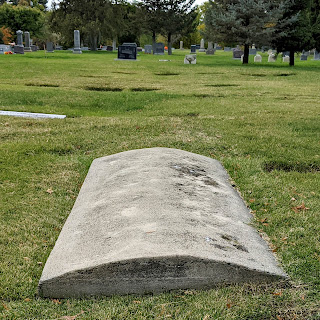
Murray City Cemetery's Unusual Bedstone

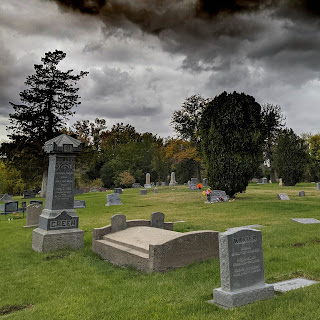
Alvin and Francis Green's grave cover in the shape of a bed,
on a stormy day in Murray City Cemetery, 2021

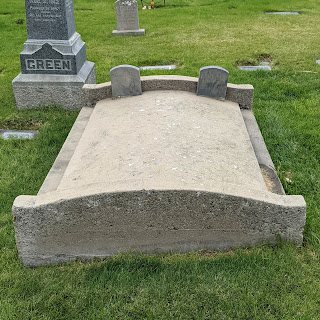
Murray City Cemetery is home to a few oddities, one of which is this concrete grave cover in the shape of a bed that marks the graves of Alvin G. and Francis Green.

The Greens were early settlers of Murray, with their family home located just east of what is now I-15 and 5300 South. Green Street is named after the family and the irrigation canal they built, the Green Ditch.

Alvin died in 1912 and his wife Francis died in 1913. They were both buried in an underground crypt with stairs leading down to doors. This style of underground crypt is not common in Utah, but Alvin was from New York and Frances (who probably arranged the burial site) was from Mississippi, where these crypts are more common. The stairs were probably at the head or the foot of the crypt as those adjacent grave spaces were empty until the 1930s and 1940s.

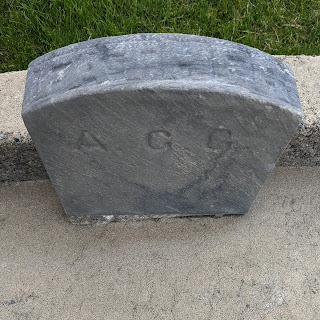
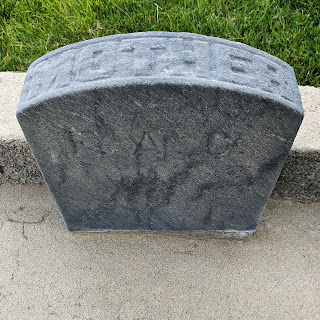
At some point (1930s or 1940s is my guess), the open hole created by the stairs was determined to be a safety hazard and was filled in and the crypt capped with concrete in the shape of the bed. Headstones with the initials of Alvin and Frances were placed like pillows on the bed.

Although this odd feature of Murray City Cemetery tends to get quite a bit of attention it is not the only grave cover in the cemetery. There is a less conspicuous concrete cover marking the graves of Franklin and Elizabeth Webb who were buried in the 1920s.

Alvin and Francis Green's grave cover.

"Father" "A. G. C."

"Mother" "F. A. G."

Alvin G. and Francis Alice Green, from FamilySearch

The less conspicuous grave cover for
Franklin and Elizabeth Webb, Murray City Cemetery, 2021

15 October 2021

SLC Council Candidates and their Views on Historic Preservation

SLC Council Ballots have gone out, so I thought I would gather some publicly available data for your consideration. No spooky stories today.
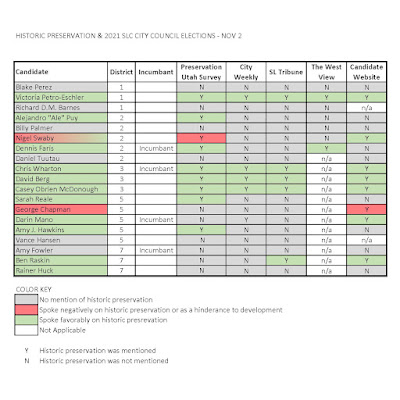
Chart of Salt Lake City Council candidates (2021)
and their views on historic preservation. 

A couple of years back a volunteer door-to-door campaign supporter for the SLC mayoral election asked me about the local issues important to me and I answered I was concerned with historic preservation. Her response was “I’ve never heard anything about that.”

I would hope that in the last 2 years that at least some of the candidates would take notice of the increased demolition of historic spaces.

This simple analysis clearly does not take into account the multitude of issues facing SLC. Candidates and voters value certain issues over others and decisions are made with those trade-offs in mind.

However, I do believe that historic preservation is intertwined with many of the most pressing issues facing SLC government such as housing affordability, distribution of density, homelessness, open/green space, sustainable growth, and environmental sustainability.

This chart is compiled from publicly available sources and shows which candidates acknowledge historic preservation as an issue. To receive a “Yes” the candidate needed to specifically mention historic spaces or preservation, not simply a vague characterization of preserving neighborhood character as that is too open to interpretation.

You can judge for yourself the effectiveness/sincerity/value of their approaches and their record on the issue.
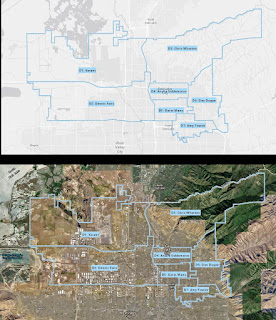
SLC Council District Maps

12 October 2021

A 1904 Ghost story at Murray City Cemetery

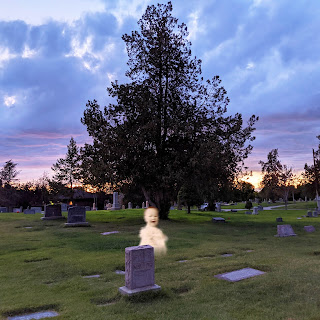
An (obvious) photoshopped image of
Murray City Cemetery and baby ghost Calvin.
Ghost stories are plentiful at Murray City Cemetery and one of the earliest is from 1904.

According to a story in the Salt Lake Tribune, a young man took a shortcut through the Murray City Cemetery to visit a young lady he fancied.

On this Wednesday night (April 27, 1904) the young man reached the middle of the cemetery and encountered a white figure that slowly emerged from the ground and hung suspended over a grave. He distinguished the outline of a small child. As he continued to gaze in fright the figure slowly disappeared sinking back into the earth.

He walked a few more paces and the ghostly figure again rose and hovered above the surface of the ground. Again, the young man stopped and again the ghost vanished. This repeated a third time at which point he turned back and fled without another look!

The Tribune’s report continues stating that Cemetery Sexton Robert Wright spoiled the ghost story. Sexton Wright said that he was digging a grave that Wednesday night that needed to be ready the next morning, April 28th. The grave was half dug when he heard a noise, so he raised his head and looked around. It was so dark he could not see anything, so he went back to digging. This happened 2 more times and then he saw a man running down the path as hard as he could go.

A few days later the Deseret News took issue with the Tribune’s reporting stating that Sexton Wright was not digging a grave that night and that there were no rumors of ghosts in the cemetery. If the Deseret News reporting is accurate and Sexton Wright was not present, perhaps the young man really did see a ghost.

In attempting to fact-check this story I found a close match to the young man’s ghost story: Two-year-old Calvin Wilson died of diphtheria on April 26, 1904 and was buried in Murray City Cemetery the following day, April 27.

The burial is one day off from the young man’s story but perhaps he misremembered the exact day. Regardless, it is a good ghost story.

Murray City Cemetery at sunset, 2021.
Family photo of baby Calvin Wilson and grandmother
Lillie Archer Wilson, from FamilySearch
Gravesite of baby Calvin Wilson, 2014 from FindAGrave

08 October 2021

Alligator in the Sewer!

Composite image showing an alligator at the
Salt Lake Hot Springs Sanitarium.
Image of Sanitarium from UDSH.
Alligator stock image from Adobe.
About 1900 a rumor emerged of an alligator living in the SLC sewers.

The Salt Lake Hot Spring Sanitarium was a bathhouse, swimming pool, and spa that used hot spring water piped from Beck’s Hot Spring. 

The building is now demolished but it was located at 52 W 300 South, which is now the site of the Broadway Media building.

(Read my previous posts about the history of the Sanitarium building and the post about a racial discrimination lawsuit involving the Sanitarium). 

In April 1902, a young man from the telephone company was sent to fix the phone lines in the basement of the Sanitarium. He was deep the back of the dimly lit basement near a long tunnel that encased the water lines connecting the Sanitarium with Beck’s Hot Spring, about 2 miles away.

He suddenly heard a curious sound and caught a glimpse of a monstrous animal scurrying back into the tunnel. The man’s hair stood up in affright and he immediately scrambled out of the basement.

The animal turned out to be an alligator named Jim that had been living in the Sanitarium’s basement and water system for the past 2 years. Jim was originally part of an exhibition of 3 juvenile alligators in the front window of the Sanitarium in 1899.

Once the alligators became too large (and no longer cute) they were disposed of; one was killed, and another was sold to the University of Utah's Biology Dept (this one died 4 months later; supposedly its brain and skin were preserved).

The story told to reporters was that Jim was found to be listless and supposedly dead, so he was thrown into the basement of the Sanitarium. The management denied any knowledge that Jim was alive and blamed its employees who left lunch scraps in the basement and who must have unknowingly kept the gator alive.

A more plausible explanation is that the Sanitarium employees knew all about Jim and kept him as their secret pet until exposed by the unsuspecting telephone employee.

Regardless of how Jim became a resident of the basement and water systems of the Sanitarium, it is unknown what happened to him after he was found out. Supposedly the management of the Sanitarium organized a posse to search out the alligator and finally dispose of him.

Of Note:
As it turns out, finding alligators in Utah is not as rare as I thought. Juvenile alligators were found in SLC in 1955 and 1956. A 2 ft long alligator was found in the Jordan River in 2003. A 3ft alligator was found in Grandpa’s Pond just outside of Hurricane in 2008. All of these were likely pets that were released by their owners. It is now illegal for a private individual to process an alligator in Utah.

Sources:
Ogden Standard Examiner 1895-08-27; SL Herald Republican 1900-03-12; SL Trib 1902-04-19; Des News 1955-08-20; KSL.com 2003-07-17; Daily Herald 2008-07-28


Officer W.A. Stround and Ronald Parry
with a baby alligator, 1955 (From UDSH).

07 October 2021

Salt Lake City's Gravity Hill

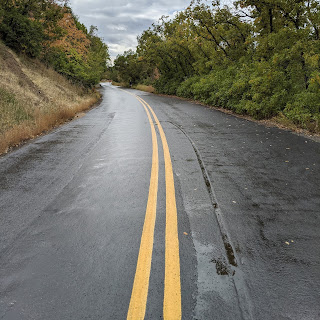
Gravity Hill, City Creek Canyon.
Looking "up" but downstream. 2021.
City Creek Canyon abounds with urban legends of hauntings and mysterious phenomena, one of these places of mystery is Gravity Hill.

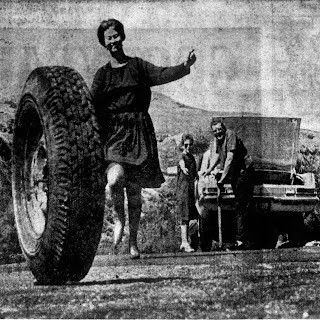
Gravity Hill is a stretch of road on Bonneville Blvd in City Creek Canyon where it appears that things, including cars, defy gravity and roll uphill. This is an optical illusion caused by an obscured view of the horizon. Gravity Hills are actually quite common and have been documented all over the world.

Some of the many stories involving SLC’s Gravity Hill involve a woman in a white dress haunting the canyon, magnets in the state capitol pulling cars upward, and a ghost of a farmer who was killed when his tractor overturned. 

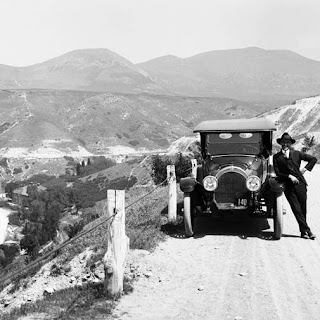
The story of Gravity Hill begins with the creation of Bonneville Blvd, which today forms a loop within the City Creek Natural Area. It can be accessed by vehicle from B Street and 11th Ave and exited on the northeast side of the State Capitol building. It was proposed in 1913 and by the 1920s the loop that we know today had been cut into the hillside and was a decent dirt road popular with motorists. The road was widened and improved in 1938.

There is no evidence that Gravity Hill was a defined location of interest during the 1920s or 1930s. My hypothesis is that the lack of trees during this time did not obscure the horizon along the roadway preventing the optical illusion.

By the 1940s the phenomenon at Gravity Hill was well-known by local Salt Lakers but it really seemed to gain popularity in the 1960s and 1970s, especially among teenagers seeking thrills and secluded spots for romantic encounters.

The flood of 1983 caused extensive damage to City Creek Canyon and after repairs and stabilization efforts were completed Bonneville Blvd was made into a one-way street for vehicles. As such, it is no longer possible to drive the south/downstream to experience the optical illusion. But cyclists and hikers can still enjoy it, simply travel downstream along the east side of Bonneville Blvd near the intersection with North Canyon Road.

Sources:
SL Herald 1916-01-06; Des News 1938-04-15; SL Trib 1945-07-17; SL Trib 1965-08-23; Des News 1991-02-18

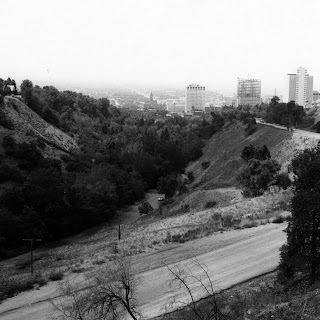
Bonneville Blvd, 1970s. From UDSH.

A tire rolling “uphill” 1965. From SL Trib 1965-08-23

Oldsmobile at 11th Ave & B St, 1919. From UDSH.

Map showing SLC's Gravity Hill. From Google Maps.

02 October 2021

500 Eels Are Creepy Creatures

American Eels. From Getty Images.

Welcome to October (and my first #SpookySLC post). And yes eels are creepy creatures and I would hate to stumble upon 500 eels.

In July 1872 Albert P. Rockwood imported 500 American Eels and released them into the Jordan River.

Rockwood was Superintendant of the Zion Cooperative Fish Farm and Utah’s first Territorial Fish Superintendent. He was tasked by Brigham Young to determine why Utah’s native trout population was declining and to increase fish populations in waters along the Wasatch Front.

In addition to trying to propagate local trout species, his approach was to import exotic fish species. In addition to the eels, he introduced King Salmon, American Shad, lobsters, oysters, Asian Carp, and numerous other species. Many of these species (especially lobsters and oysters) failed immediately but we are now living with many of the impacts of his efforts such as the abundance of carp just about everywhere.

In 1871 Rockwood built a fish farm in Sugar House- probably near what is now the Forest Dale Golf Course. On the 20-acre farm he build a hatching house and 12 fish ponds fed by a large spring with water at a constant temperature of 55 degrees.

Rockwood’s trial-and-error methods combined with regular reports of his efforts and correspondence with the Smithsonian Institute means that his enterprise was the first scientific fish hatchery in the world.

One of his first attempts at fish farming was to import 500 baby American Eels from the Connecticut River in Massachusetts. Once the eels were about 4 in long he released them into a nearby tributary of the Jordan River.

The eels were seen sporadically over the next few years. One was caught and released in Sept 1874 in Utah Lake near the mouth of the Provo River, it measured 2 feet long.

Another was found dead in Jan 1875 along the shore of the Great Salt Lake near Centerville and was eaten by its finders who said “it was cooked and found to be well pickled in salt.”

The last sighting of a living eel was in the Jordan River just south of SLC in 1875.

Rockwood died in 1879 but others continued his fish farming experiments, thankfully without the eels.

Sources:
Utah Stories Sugar House Prison Farm by Lynne Olson; SL Herald Republican 1871-07-30; Des News 1873-03-26; Utah County Times 1874-09-10; Des News 1875-08-25; Des News 1875-01-27; Des News 1876-02-03; SL Herald Republican 1879-11-27; The Phrenological Journal and Life Illustrated Jan 1874.

American Eel, image from USFWS.